
Our Executive Education
Executive Education
1. High-level access
Meet senior voices from sport, diplomacy, football governance and public institutions in a closed executive setting.
2. Inside the Swiss sport ecosystem
Discover how Geneva, Vaud connect diplomacy, federations, Olympic institutions and football governance.
3. Diplomatic protocol in practice
Learn how official delegations are welcomed, seated, managed and guided around an international football fixture.
4. Diplomatic and institutional networking
Build relationships with participants and speakers from Geneva, Lausanne, sport organisations, business and public affairs.
5. Match-day diplomacy in practice
Observe live football operations, from VIP and diplomatic delegation flows and hospitality to accreditation, protocol, media and security coordination, subject to final access approval.
6. Sport diplomacy and public policy insight
Leave with frameworks to understand influence, manage sensitive dossiers, read institutional dynamics and position yourself in global sport.
Learning to excel and navigate in Sports diplomacy
We deliver bespoke, discreet and personalised executive training for sport diplomats and senior stakeholders working across international sport governance as well as conventional diplomats who are keen about learning how to leverage the power of sport in diplomatic work.
Formats range from one to one briefings to small, confidential group sessions, delivered in Geneva or on location. Our programmes focus on how international sport actually functions: institutions, decision-making, influence, bidding processes, reputational risk, and the geopolitics that shape governance outcomes. Football is used as a primary lens, with additional modules available for other sports.
Our Open Enrolment Courses address a broad range of current and emerging challenges, and are delivered in flexible formats — in person, online, and hybrid — as part of our Flex Learn approach.
Our SwissDO Flagship programme
Sports geopolitics and global sport governance
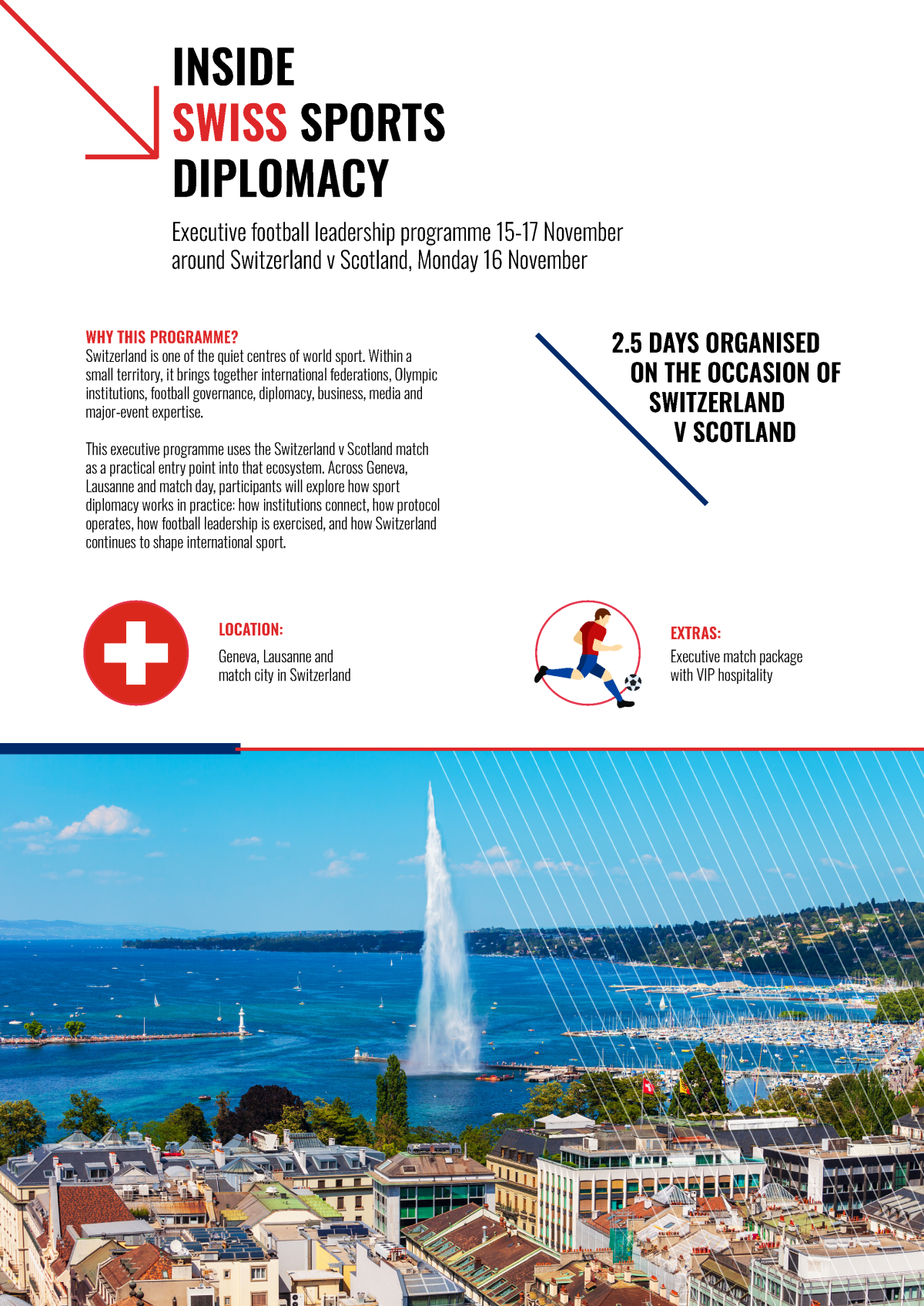
2,5-day intensive executive programme
This SwissDO flagship crash course gives participants a practical introduction to modern sports geopolitics, global sport governance and football leadership. Across three days, participants will move through Switzerland’s sport governance ecosystem: Geneva’s diplomatic environment, Lausanne’s Olympic and federation network, and a live international match setting. The programme combines expert briefings, executive discussions, match-day observation, protocol exposure and VIP hospitality (in case of an event).
Programme structure
Day 1: The governance map // Geneva
The first day introduces the international sport ecosystem and Switzerland’s position within it. Participants examine how power, influence and decision-making move between international federations, national associations, governments, cities, sponsors, broadcasters, legal bodies and major-event organisers.The Geneva setting gives the programme its diplomatic entry point. Sessions connect sport governance with international organisations, public diplomacy, multilateral dialogue and the Swiss tradition of discreet institutional hosting.Participants will work on questions such as: who shapes global sport decisions, how alliances are built, how federations interact with public authorities, and why Switzerland remains one of the main operating bases for international sport.
Main themes
International federations and their governance models
FIFA, UEFA, the IOC, CAS and the Swiss-based sport ecosystem
The role of governments, embassies and public authorities in sport
Geneva as a diplomatic environment for sport, rights, development and dialogue
How sport institutions use Switzerland for headquarters, meetings, legal stability and international access
Day 2: Geopolitics, protocol and sport business // Lausanne
The second day moves from governance theory to live practice. Built around the Switzerland v Scotland match, it examines how football becomes a diplomatic and commercial stage: national representation, federation guests, VIP flows, media attention, sponsors, security, hospitality and public messaging.A dedicated session on Protocole à la Genevoise prepares participants to read the match-day environment through a diplomatic lens. This approach is based on precision, discretion, neutrality, sequencing and respect for institutional rank. It looks at how officials are welcomed, how delegations are seated, how guest movements are planned, how hosts manage visibility, and how protocol helps avoid mistakes in sensitive settings.The match-day module connects diplomatic protocol with football operations. Participants observe how an international fixture is prepared and delivered, subject to accreditation, security rules and final access conditions.
Main themes
- Sport as a diplomatic and commercial instrument
- Sport entertainement (e.g. Football/Ice Hockey matches) as spaces for representation, relationship-building and soft power
- Protocole à la Genevoise: welcoming delegations, precedence, seating, guest flows and institutional courtesy
- VIP hospitality, federation guests, sponsors and public authorities
- Match-day operations: accreditation, access, media, security coordination and guest management
- How post-match follow-up can turn a sporting event into a diplomatic or business opportunity
Day 3: Integrity, risk and executive decision-making // Geneva-Lausanne
The third day takes participants into Lausanne’s Olympic and federation environment. The focus shifts to governance standards, institutional risk and executive decision-making in global sport.Participants examine how sport leaders deal with sensitive dossiers: integrity concerns, compliance issues, media pressure, commercial conflicts, political exposure, human rights questions and reputational risk. The Lausanne setting connects these questions to the Olympic Capital, the Court of Arbitration for Sport, international federations and the wider Swiss sport governance network.The day is designed for executives who need to understand how decisions are made under pressure, how institutions protect credibility, and how leaders manage stakeholders when sport becomes political, commercial or legally sensitive.
Main themes
- Lausanne as Olympic Capital and federation hub and Sports Tech Hub
- Governance standards and compliance expectations in international sport
- Integrity, ethics, safeguarding and institutional accountability
- Media pressure, public communication and crisis handling
- Commercial interests, sponsors and reputational exposure
- Decision-making under pressure: how executives manage sensitive sport dossiers
What participants take away
Participants leave with a practical understanding of global sport governance and sports geopolitics. They will be able to read institutional dynamics, identify centres of influence, understand how sport bodies interact with governments and federations, and assess how major matches and events create diplomatic, commercial and reputational opportunities.They also receive case-based frameworks to support negotiations, partnerships, public positioning and executive decision-making in sport. The programme is designed for participants who need to work across sport, diplomacy, governance, business and public affairs.
Final match-day access remains subject to accreditation, security rules and federation approval.

Sports Diplomacy
Confidential briefings and facilitation on sport governance and geopolitics. We support engagement strategies for governments, business federations and partners, from stakeholder mapping to integrity and crisis management.

Protocole à la genevoise
Guidance to learn from exclusive Geneva’s multilateral environment and Switzerland’s institutional landscape. Protocol support, introductions and discreet convening that connect authorities, international organisations and Swiss sport business.

Executive Education
Bespoke executive programmes for diplomats and senior leaders. Short intensives, case studies and simulations covering governance structures, sports geopolitics, major events and executive decision-making.